The Complete Guide to Agency Client Retention
Why clients really leave, what the data says, and how the best agencies retain over 92% of their clients
Your clients are not leaving because of bad results.
Not because of pricing. Not because a competitor made a better offer. In the vast majority of cases they're leaving because of hundreds of small moments that happened on calls over the previous two or three months. Moments your account managers experienced, tried to handle, thought they fixed, and never told you about.
This is the truth about agency client churn that almost nobody talks about. Not because it's a secret. Because the people who know it — your account managers — have every reason not to say it out loud.
This guide is written from inside that reality. From years spent as a retention manager reviewing cancellation cases at some of the world's leading agencies. It's the story of what actually happens in agencies every single day — told from the perspective of the people closest to your client relationships. Not because account managers are doing anything wrong. Because the system they're operating in makes it almost impossible for the right information to reach the right people at the right time.
By the end you'll understand exactly why clients churn, why your current setup makes it nearly impossible to see it coming, and what a small number of elite agencies do differently to retain clients at a rate that seems almost unfair compared to everyone else.
The good news: every single thing we're about to describe is preventable.
Inside the AM's World: The Human Reality of Client Churn
To understand why agency client churn is so hard to prevent, you have to understand the world your account managers are actually living in.
It is not the world your clients think they're operating in.
For a business owner who has hired your agency, this relationship is one of the most consequential decisions they've made this year. Their marketing budget — often a significant chunk of their total operating spend — is in your hands. Their growth targets. Their investor commitments. Their ability to hire. Their P&L. Sometimes their entire livelihood is influenced by how well this engagement goes.
They are not one of many. You are their agency. The one they bet on.
For your account manager, that same client is one of fifteen. One of twenty. One of the many relationships they are trying to maintain, service, grow, and report on simultaneously — while hitting their own targets, sitting in internal meetings, onboarding new clients, and managing the relentless demands of agency life.
This isn't a criticism of account managers. It's simply the structural reality of the agency model. And it creates a disconnect that runs through every single client relationship your agency has — a gap between how much the client needs from the relationship and how much bandwidth the AM realistically has to give.
Most of the time that gap is manageable. The client is happy enough. The results are solid enough. The calls are fine.
Fine. That's the dangerous word.
Because fine is not what your client is hoping for when they dial into that monthly call. They're hoping for enthusiasm. New ideas. Someone who has been thinking about their business between calls. A partner who understands their world well enough to bring something unexpected to the table. The feeling — even briefly — that they are the most important client on that AM's list.
When they don't get that consistently, something shifts. Quietly. Almost imperceptibly at first.
The calls get a little shorter. The client becomes a little more agreeable — nodding along, saying yes to everything, asking fewer questions. On the surface it looks fine. The AM hangs up and moves on. Nothing was obviously wrong. Nothing was obviously right. Just quiet.
But that quietness is a signal. A client who has stopped asking questions is not a satisfied client. A client who agrees with everything is not an engaged client. A client whose calls are getting progressively shorter is not a busy client.
They are a disengaging client. And in many cases they've already made their decision.
The AM doesn't see this. Not because they're not good at their job. Because they have nineteen other clients, and nothing on that call was obviously wrong enough to register. In the context of everything else they're managing, a slightly quiet client barely rates a mention.
So they move on. And the client moves closer to the door.
Then something tips it. A bad month of results. A competitor reaches out. A stressful board meeting where the client needs reassurance that never comes. Whatever it is — it's the final straw, not the cause. The cause was the slow, quiet drift that had been building for months.
The AM gets the email. Begrudgingly walks it over to their manager. "I've got another one." Or worse — lets it sit for a day, too embarrassed to bring it up, before eventually sending it through.
Here's what makes this genuinely systemic rather than just human: even when an AM does notice something is wrong, everything around them works against doing anything about it.
Flagging a struggling client relationship to your manager is not a neutral act. It's an admission. It's saying out loud — in a profession where confidence and competence are everything — that something is going wrong on your watch. That you don't have it under control.
Most AMs would rather fix it themselves. Handle it on the next call. Send a thoughtful email. Propose a new idea. Hope the next set of results buys another month.
Sometimes it works. More often it doesn't. And while they're hoping, the client is quietly calling other agencies.
The "I fixed it" trap is one of the most common patterns in client churn. An AM handles a difficult moment on a call — a client raises a concern, the AM responds well, the tension lifts. The AM hangs up feeling like it's resolved. They never report it to their manager because as far as they're concerned it's done.
But the client didn't feel it was resolved. Not fully. Something underneath didn't get addressed. Something they didn't quite say. And now it sits there, quietly, alongside everything else that's been building for the past two months.
The manager never knows the concern was raised. The founder never knows. The next call happens and everything seems fine.
Until it isn't.
This is the invisible layer of agency client churn. Not dramatic failures. Not obvious mistakes. Hundreds of small moments — a concern not fully addressed, a call that ran a little short, a question that stopped being asked, an idea that never got proposed — accumulating silently over months until a client who was never visibly unhappy sends an email saying they're moving on.
When you go back and look at the calls — as we have done hundreds of times across some of the world's leading agencies — the trail is always there. Every single time.
The signals were in the calls. The tone shifts. The shortened meetings. The overly agreeable client who stopped pushing back. The AM who thought everything was fine because nothing was obviously wrong.
9 out of 10 times it was preventable. The only thing missing was a way to see it.
The Data: What The Numbers Say About Agency Client Retention
9 out of 10 client cancellations are preventable.
Not a projection. Not a model. The finding from reviewing hundreds of real cancellation cases across some of the world's leading agencies. Every case. Every cancellation. Reviewed in detail. And in 9 out of 10 of them, the signals were there in the communication between the account manager and the client weeks — sometimes months — before the cancellation email arrived.
Not vague signals. Specific, identifiable, measurable ones. Tone shifts. Declining engagement. Unresolved concerns that were raised and never properly addressed. Questions that stopped being asked. Enthusiasm that quietly drained out of every interaction over months.
The relationship didn't collapse overnight. It deteriorated slowly, visibly, in plain sight. And nobody caught it in time.
That single finding reframes everything about how agencies should think about retention. Because if 9 out of 10 cancellations are preventable — and the evidence says they are — the question is no longer "why do clients leave?" It's "why aren't we seeing it coming?"
The external research tells the same story from a different angle.
A 10-year study by consultancy group Aprais analysed data from over 23,000 agency clients and found that the quality of the relationship now outstrips functional skills as the primary driver of client retention. How you make clients feel matters more than what you deliver. That's not a soft, feel-good finding. That's 23,000 data points over a decade arriving at the same conclusion.
Research into why clients leave is equally consistent. 68% cite a lack of proactive strategic guidance — their agency stopped bringing ideas and started just executing requests. 57% point to poor communication and transparency. 53% say their agency failed to demonstrate value in terms that actually mattered to them.
Notice what's not on that list. Bad results. Wrong strategy. Poor targeting. The things agencies spend 90% of their energy perfecting are not what's driving churn.
And in over 60% of cancellation cases, clear signs of dissatisfaction were visible in call data from the three months prior to cancellation. The account manager had been on those calls. The signals were there. But without a system to track, score, and flag relationship health over time — nobody connected the dots until it was too late.
9 out of 10 were preventable. The only thing missing was visibility.
The Real Cost of Losing a Client
A 1% improvement in client retention is worth more to your agency's bottom line than a 10% increase in new business revenue.
Most agency owners have it completely backwards.
The entire industry is obsessed with new business. The pitch. The proposal. The win. New business gets the celebrations, the case studies, the conference talks. Retention is the quiet, unglamorous back-office problem nobody puts on a trophy.
But the maths is unambiguous.
Retained revenue costs almost nothing to keep. New revenue costs everything to find. And yet the average agency invests the vast majority of its time, energy, and budget chasing the thing that costs more and delivers less — while the thing that compounds quietly and costs almost nothing gets managed reactively, inconsistently, and almost always too late.
Here's what that actually costs in real terms.
Most agency owners think about a lost client in terms of the monthly retainer. A client at £5,000 a month cancels. That's £5,000 gone. Painful. You replace them. You move on.
Wrong number entirely.
The average agency client stays for around 2 years. At £5,000 a month that's £120,000 in lifetime value. Every client you lose is not a £5,000 problem. It's a £120,000 problem.
Now add the replacement cost. Acquiring a new client costs five to seven times more than retaining an existing one. The sales calls, the pitch process, the proposals, the time your senior people spend selling instead of serving, the onboarding, the three to six months it takes a new client to reach the profitability of a long-standing one. A conservative estimate puts the true cost of replacing a lost client at £15,000 to £25,000 in time, resource, and lost margin.
The real cost of one lost client is closer to £140,000.
Multiply that across a year. The average agency retains around 80% of its clients annually. For an agency with 20 clients at £5,000 a month that's 4 clients lost every year. At £140,000 true cost per client that's over half a million pounds leaving through the back door — while the agency focuses all its energy on winning new business through the front.
The best agencies in the world retain over 92% of their clients. The difference between an 80% retention agency and a 92% retention agency — same size, same services, same pricing — compounds into millions of pounds over five years. Not because they do better work. Not because they charge less. Because they see the warning signals earlier and act on them before the client makes their decision.
Here's what makes all of this truly painful.
9 out of 10 of those cancellations were preventable. Which means most of that half a million pounds wasn't inevitable. It wasn't bad work. It wasn't a difficult market. It wasn't bad luck.
It was warning signals that nobody saw in time.
The agencies winning at retention aren't just better at client relationships. They're better businesses. They grow faster, spend less on sales, carry more predictable revenue, and build the kind of client base that refers new business without being asked. They spend less time firefighting and more time growing.
And it all starts with one thing: seeing the warning signals before it's too late.
Right now most agencies have no system for that at all.
Why Clients Really Leave Their Agency
It is almost never about the results.
That's the hardest thing for most agency owners to accept. Because results are what the agency lives and dies by. What the team works late for. What gets celebrated internally, put in case studies, presented on monthly reports with colour-coded graphs and year-on-year comparisons.
And yet.
A 10-year study analysing data from over 23,000 agency clients found that the quality of the relationship now outstrips functional skills as the primary driver of whether a client stays or leaves. Not campaign performance. Not strategy. The relationship. How it felt to be their client.
The research into why clients leave tells the same story every time. 68% cite a lack of proactive strategic guidance. 57% point to poor communication and transparency. 53% say their agency failed to demonstrate value in terms that mattered to them.
Not one of those reasons is about performance.
They're all about how the client felt. Whether they felt heard. Whether they felt like a priority. Whether they felt like their agency was genuinely invested in their success or just processing their retainer.
The number one reason clients leave — cited consistently across every study, every survey, every piece of research on this topic — is perceived indifference. Not poor results. Not high pricing. Not a competitor making a better offer.
The feeling that their agency doesn't really care.
Here's the devastating irony: in almost every case, the agency does care. The account manager cares. The team cares. The founder cares. But somewhere in the gap between what the agency knows it's doing and what the client actually experiences on those monthly calls, the signal gets lost.
The client stops feeling it.
The enthusiasm. The curiosity. The sense that someone on the other end of the call has been thinking about their business between meetings. That quiet confidence that comes from working with someone who genuinely understands your world and brings something unexpected to the table.
When those things are consistently present a client doesn't just stay — they refer, they expand, they become advocates who bring new business without being asked. When those things are consistently absent — even subtly, even occasionally — a client starts to drift. They don't complain. They don't send a difficult email. They just quietly start to wonder whether there's something better out there.
And then one day there is.
The other thing almost nobody talks about: clients rarely leave in a moment. They leave over months. The decision to cancel is almost always the end of a long, quiet process of emotional disengagement that started long before anyone at the agency knew something was wrong.
By the time the cancellation email arrives the client has already grieved the relationship. Already had the internal conversations. Already done the research. The email is just the administrative confirmation of something that was decided weeks ago.
Which means that by the time you know there's a problem, it's already too late to fix it.
The only way to retain clients at the level the best agencies do is to catch the drift before it becomes a decision. To see the signals when they're still small enough to act on. To know — not guess, not hope, but know — which relationships need attention right now, before the client has even consciously decided they're unhappy.
That requires something most agencies don't have. Visibility.
The Visibility Problem: Why Agencies Can't See Client Churn Coming
Here's the uncomfortable truth about how most agencies monitor their client relationships.
They don't. Not really. Not systematically. Not in any way that would reliably catch a relationship deteriorating before it's too late.
What they have instead is a patchwork of informal signals. A manager who checks in with AMs in a weekly meeting. A quarterly review where client health gets discussed in broad strokes. A gut feeling from a founder who used to be on every call but hasn't been for years. A RAG status on a spreadsheet that gets updated when someone remembers — and that almost always says green until the week it says red.
This isn't a criticism. It's what happens when a business scales faster than its systems. When an agency has 5 clients the founder knows every relationship intimately. When it has 50 the founder is relying entirely on what their managers tell them. And the managers are relying entirely on what their AMs tell them.
As we established earlier — what AMs tell their managers and what is actually happening in client calls are very often two completely different things.
The visibility problem operates at three distinct levels. At every level the information that would allow someone to act gets filtered, softened, delayed, or lost entirely.
The AM
The AM is closest to the client relationship. On every call. They hear the tone shifts. They notice when a client who used to ask lots of questions goes quiet. They feel the calls getting shorter.
But they're also the person with the least incentive to escalate. Raising a struggling relationship with their manager is an admission of vulnerability in a profession that rewards confidence. So they handle it themselves. Try to fix it on the next call. Hope the results improve. Wait.
And while they wait the client drifts further.
The Manager
The manager's view of client health is almost entirely secondhand. They know what their AMs tell them. They see the monthly results. They sit in on the occasional call. But they have no way of knowing what actually happened on the calls they weren't on. No way of knowing which clients raised concerns that were handled but never escalated. No way of knowing which relationships are quietly deteriorating beneath a surface that looks perfectly fine.
Their instinct might tell them something is off with a particular account. But instinct is not a system. Without data to back it up it rarely translates into early intervention.
The Founder
The founder is furthest from the calls and closest to the consequences. They find out about client problems in one of three ways. Their manager tells them — which means the problem was already serious enough to escalate. The client contacts them directly — which means the relationship has broken down badly enough for the client to go around their AM. Or they get the cancellation email — which means it's already over.
In all three scenarios the founder is the last to know. And by the time they know it is almost always too late to do anything meaningful.
This is the visibility problem in its entirety. Not a failure of people. Not a failure of effort. A failure of information flow. The signals that would allow someone to intervene early exist — they're in the calls, in the data, in the patterns of how relationships evolve over time — but there is no system to surface them to the people who have the power to act on them.
The result is an industry where 9 out of 10 cancellations are preventable in theory but almost never prevented in practice. Where the most important asset a services business has — its existing client relationships — gets managed reactively, inconsistently, and almost always too late.
Where a founder who genuinely cares about every client on their roster has no reliable way of knowing which ones are thinking about leaving until the Monday morning email arrives.
There is a better way.
What The Best Agencies Do Differently
The agencies with the highest client retention rates don't have a secret. They have a system.
It's not complicated. It's not built on revolutionary ideas about client management or groundbreaking new approaches to account servicing. It's built on one principle that most agencies understand intellectually but almost none actually operationalise:
The earlier you identify a problem in a client relationship, the easier it is to fix.
That's it. That's the whole thing.
A client who is mildly disengaged after two months can be re-engaged with a proactive call, a new idea, a genuine conversation about their business. A client who has been quietly disengaging for six months and is already talking to other agencies cannot. The intervention window closes fast. The best agencies catch problems while that window is still open.
Here's what that looks like in practice.
They treat relationship health as a metric
The best agencies don't just track campaign performance. They track relationship health. They have a way of scoring how each client relationship is trending over time — not just whether results are good, but whether the client is engaged, asking questions, bringing their team to calls, responding to new ideas with enthusiasm or polite indifference.
They know the difference between a client who is satisfied and one who is merely tolerating. And they act on that difference before it becomes a problem.
They create safe channels for AMs to escalate
The best agencies have solved the escalation problem. They've built cultures where an AM flagging a struggling client relationship is not an admission of failure — it's professional, expected behaviour that gets rewarded rather than punished.
When an AM says "I think this relationship needs some attention" the response is immediate, collaborative action. A manager jumps on the next call. The founder sends a personal note. A new proposal gets prepared. The client feels — suddenly, unmistakably — that they matter.
That shift from reactive to proactive is the single most powerful retention move an agency can make. It only happens when AMs feel safe raising the flag early.
They systematise the pre-call brief
Elite account managers don't wing their client calls. Before every significant interaction they review the relationship history. What was discussed last time. What was promised. What the client raised that wasn't fully resolved. What new idea they can bring that proves they've been thinking about the client's business between calls.
This preparation is the difference between a call that makes a client feel like a priority and a call that makes them feel like one of many. It takes fifteen minutes. It changes everything.
They make innovation a habit not an event
Clients leave when they feel their agency has stopped bringing new ideas. Not when results drop. Not when budgets get tight. When the calls start feeling like status updates instead of strategic conversations.
The best agencies build innovation into their account management rhythm. Every client call has a new idea. Every monthly report has a forward-looking recommendation. Every quarter brings something unexpected that makes the client think — these people are genuinely invested in our growth.
That consistent demonstration of proactive thinking is what separates 92% retention agencies from 80% retention agencies.
They use data to see what instincts miss
Gut feeling is not a retention strategy. The best agencies understand that human instinct — however experienced — misses things. An AM with twenty clients cannot hold the full relationship history of every one of them in their head. A manager who sits in on one call a month cannot track the subtle shifts in tone and engagement that predict churn weeks in advance.
The agencies winning at retention use data to see what their instincts miss. They track patterns over time. They flag anomalies. They surface the quiet signals — the shortened calls, the overly agreeable client, the question that stopped being asked — before they accumulate into a decision.
They don't rely on their AMs to notice everything. They build systems that notice for them.
The result
Agencies that operate this way build fundamentally different businesses. More predictable revenue. Less stressed teams. A constant flow of referrals from long-standing clients who trust them deeply. Account managers who are better coached, more confident, and more effective — because they get real feedback on every call instead of finding out something went wrong months later.
Less time firefighting. More time growing.
And almost no cancellation emails they didn't see coming.
The Solution: Visibility Into Every Client Relationship
Everything in this guide points to the same conclusion.
The problem isn't effort. Agencies work hard. Account managers care about their clients. Managers want to retain every account. Founders lose sleep over cancellation emails.
The problem is visibility. The right information is not reaching the right people at the right time. The signals that predict client churn exist — they are in every call, in every interaction, in the patterns of how relationships evolve over months — but there has never been a reliable system to surface them before it's too late.
Until now.
Chin-Wag is the first platform built specifically to solve the agency client retention problem. Not a generic communication tool. Not a CRM with a retention module bolted on. A system built from the ground up around one purpose: giving agencies the visibility they need to see which client relationships are at risk before the client makes their decision.
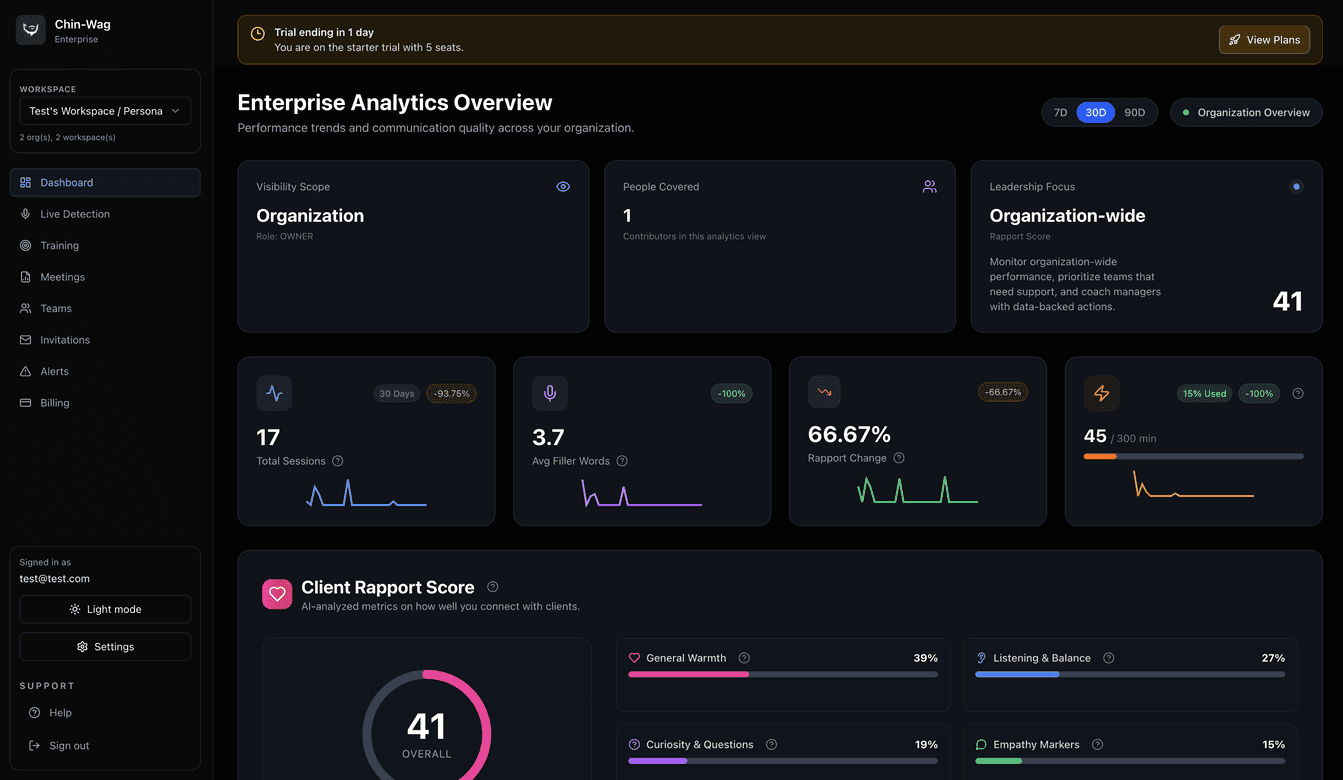
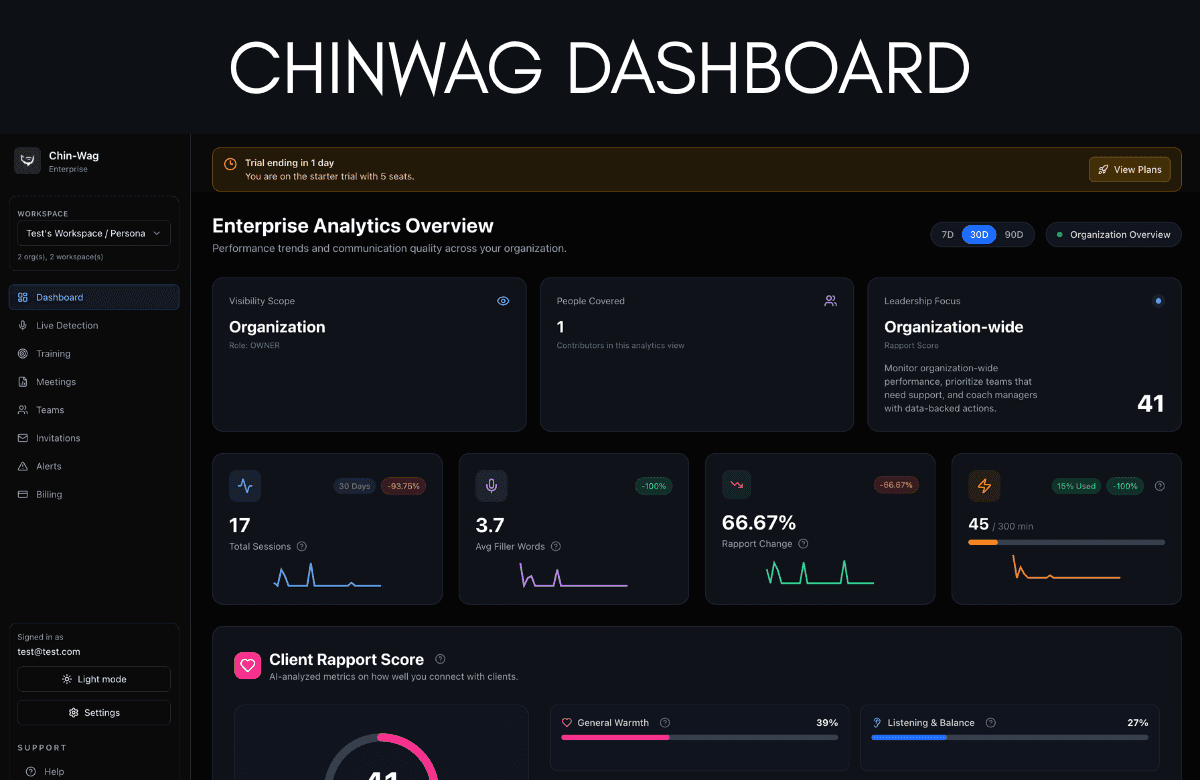
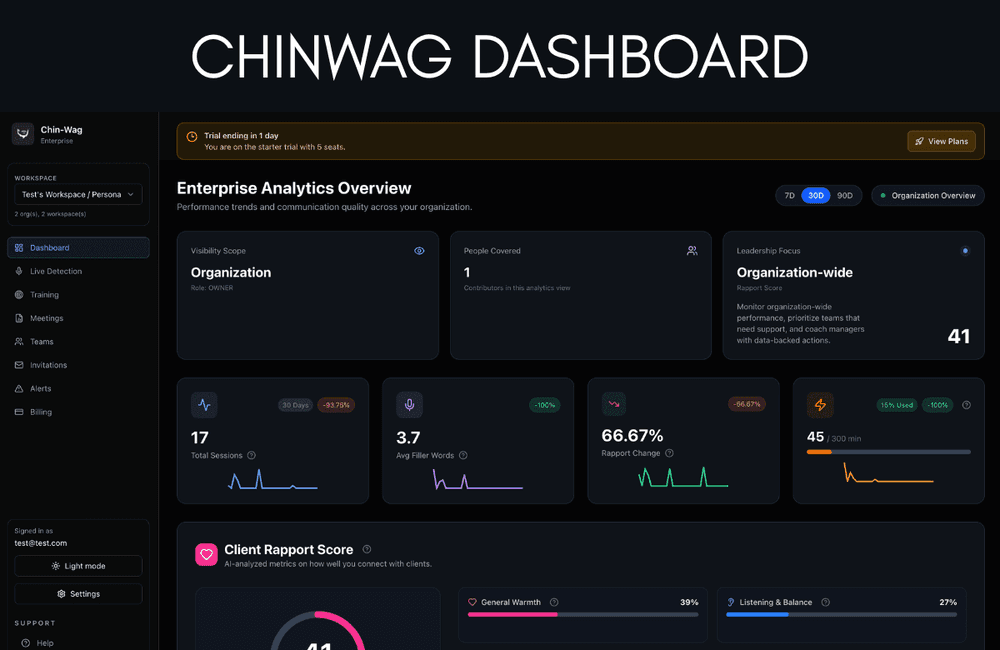
Every client call is automatically recorded and analysed. Not just transcribed — analysed. Chin-Wag measures the signals that actually predict relationship health: the rapport between the AM and the client, the balance of the conversation, the questions being asked, the tone, the engagement, the presence or absence of the enthusiasm and curiosity that keeps clients feeling like a priority.
Every call produces a Rapport Score — a data-driven measure of relationship health built from six dimensions: warmth, listening, curiosity, empathy, structure, and confidence. Not a vanity metric. A genuine early warning system built on the leading indicators of client churn identified across hundreds of real cancellation cases.
Over time those scores build into a picture. A relationship health timeline for every client, every account manager, across the entire agency. A manager can see at a glance which relationships are healthy, which ones are drifting, and which ones need immediate attention. Not from a gut feeling. Not from a weekly check-in with an AM who has every incentive to say everything is fine. From data.
The alerts fire before the problem becomes a crisis. A client whose rapport score has been declining for three consecutive calls. An AM whose talk ratio is dominating every interaction. A relationship where no new idea has been proposed in six weeks. A call where a concern was raised and left unresolved. Chin-Wag catches these signals automatically and surfaces them to the people who need to act — while there is still time to act.
The pre-call intelligence brief prepares every AM before every significant client interaction. What was discussed last time. What was left unresolved. What the relationship trend looks like. What to raise, what to ask, what to bring to the table to make this client feel like a priority. Fifteen minutes of preparation that transforms a status update call into a strategic conversation.
For account managers — the people closest to the problem and furthest from the support — Chin-Wag provides something that hasn't existed before. Personalised, specific, data-driven coaching based on their actual calls. Not generic sales training. Feedback that says: on your last three calls with this client you spoke for 85% of the time. You haven't asked a strategic question in four sessions. The client's engagement score has dropped 12 points since January. Here is what to do differently.
The result is an agency where the AM who used to silently hope a struggling relationship would fix itself now has the data, the preparation, and the coaching to actually fix it. Where the manager who used to rely on secondhand information now has full visibility across every client relationship on their team. Where the founder who used to find out about problems when the cancellation email arrived now finds out weeks earlier — when there is still something they can do about it.
The 9 out of 10 cancellations our research found were preventable — Chin-Wag is the system that prevents them. Not by working harder. Not by hiring better account managers. By seeing things earlier.
How To Get Started
If you've read this far, you already know whether Chin-Wag is right for your agency.
You've recognised the Monday morning email. You've seen the AM who thought they fixed it. You've felt the frustration of a cancellation that made complete sense in hindsight but blindsided you at the time. You know there are relationships on your team right now that are drifting — and you have no reliable way of knowing which ones.
That's exactly what Chin-Wag was built for.
Getting started takes less than 15 minutes. Connect your calendar, invite your team, and Chin-Wag joins your next client call automatically. No manual setup per call. No new workflow for your AMs to learn. It works quietly in the background, building a picture of every client relationship from the very first session.
By the end of your first month you'll know which client relationships are healthy, which ones need attention, and exactly what your account managers need to do differently to strengthen the ones at risk.
No more waiting for the cancellation email to find out something went wrong.
Start your free 30-day trial at chin-wag.ai
No credit card required. Full access from day one. Cancel anytime.